
Comprehensive Guide on Real Estate Investing in Nigeria
5 Key Real Estate Corridors to Invest in Right Now for Maximum Capital Appreciation
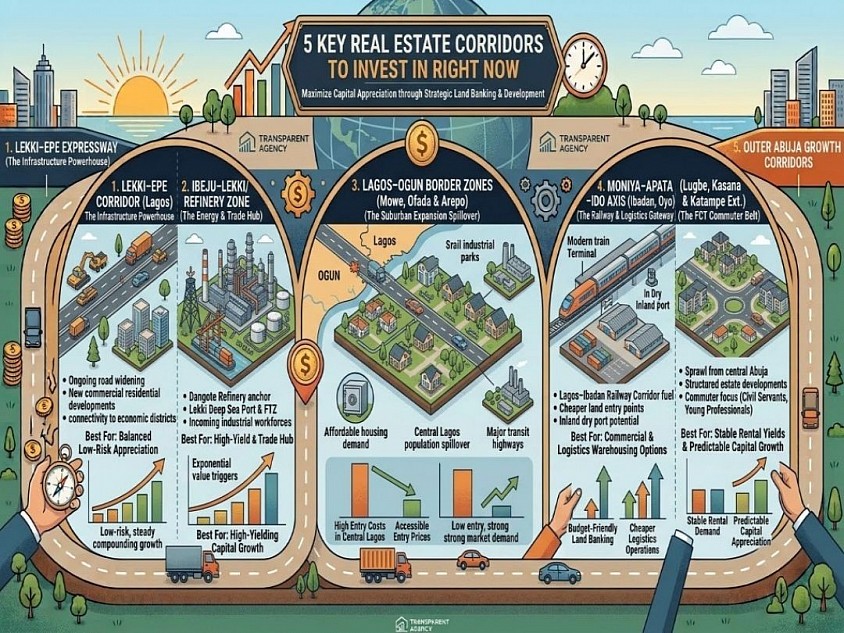
Top 5 real estate corridors to invest in
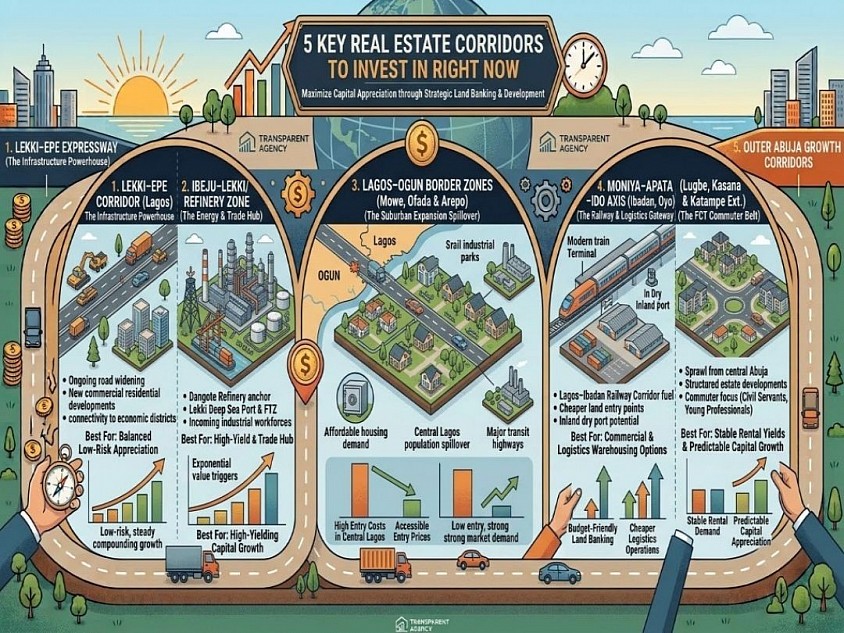
Here are 5 Key Real Estate Corridors to Invest in Right Now for maximum capital appreciation:
1. Lekki–Epe Expressway Corridor (Lagos State)
- The Pitch: "The Infrastructure Powerhouse"
- Primary Drivers: Ongoing road widening, new commercial residential developments, and strategic connectivity to major economic districts.
- Best For: Balanced, low-risk appreciation paired with steady long-term residential and commercial demand.
2. Ibeju-Lekki / Refinery Zone (Lagos State)
- The Pitch: "The Energy & Trade Hub"
- Primary Drivers: Anchored by mega-projects including the Dangote Refinery, Lekki Deep Sea Port, and the Lekki Free Trade Zone.
- Best For: High-yielding capital growth and land banking driven by incoming industrial workforces.
3. Lagos–Ogun Border Zones (Mowe, Ofada & Arepo)
- The Pitch: "The Suburban Expansion Spillover"
- Primary Drivers: High demand for affordable housing as the growing population shifts outward from central Lagos along major transit highways.
- Best For: Accessible entry-level prices with strong, consistent land appreciation and residential estate development.
4. Moniya–Apata–Ido Axis (Ibadan, Oyo State)
- The Pitch: "The Railway & Logistics Gateway"
- Primary Drivers: Fuelled by the Lagos–Ibadan Railway Corridor, dry inland port developments, and cheaper land entry points.
- Best For: Budget-friendly land banking and commercial/logistics warehousing options.
5. Outer Abuja Growth Corridors (Lugbe, Karsana & Katampe Ext.)
- The Pitch: "The FCT Commuter Belt"
- Primary Drivers: Rapid urban sprawl from saturated central Abuja, attracting civil servants, young professionals, and private sector workers.
- Best For: Stable residential rental yields combined with predictable capital growth in structured estate developments.
Real Estate
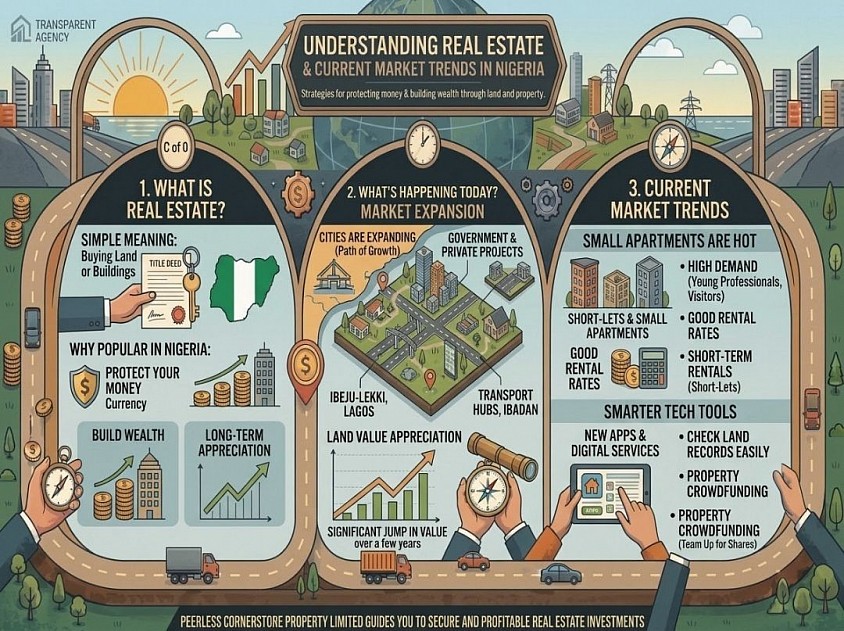
Real Estate meaning
Real estate simply means buying land or buildings. In Nigeria, it is one of the most popular ways to protect your money and build wealth over time.
What is Happening in the Market Today?
- Cities Are Expanding: Areas where government and private companies are building new roads and projects (like around Ibeju-Lekki in Lagos or transport hubs near Ibadan) are growing fast. Land bought in these places can jump significantly in value over a few years.
- Small Apartments Are Hot: Short-term rentals (popularly called "short-lets") and small 1- or 2-bedroom apartments are in high demand. Young professionals and visitors prefer them, which means owners can charge good rental rates.
- Smarter Tech Tools: New apps and digital services make it easier to check land ownership records and even allow people to team up to buy shares of a property together
C of O vs. Governor's Consent: What's the Difference and Which is Safer?
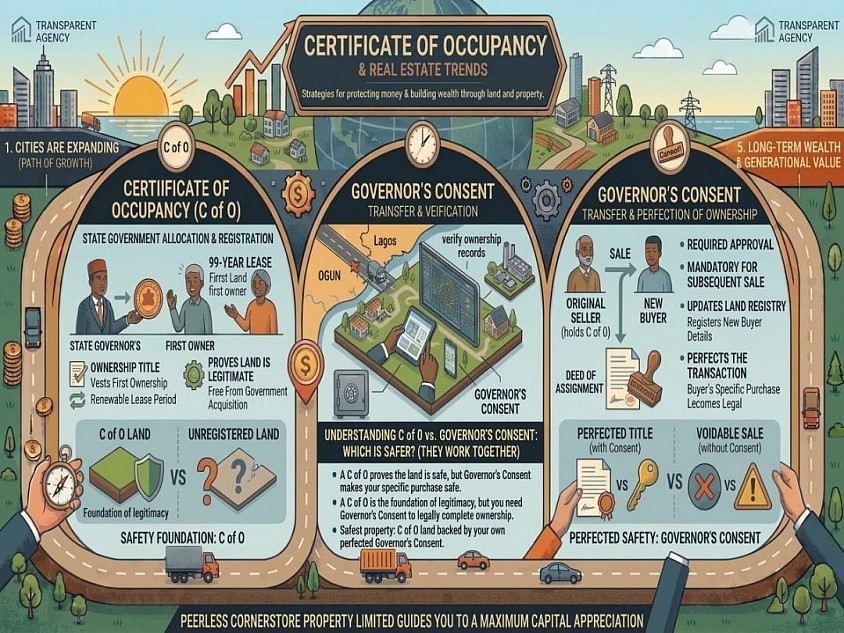
C of O and Governor's Consent
1. Certificate of Occupancy (C of O)
What it is: The first-ever title document issued by the State Governor when land is first allocated or registered, granting ownership for a 99-year lease.
Why it matters: It proves that the land is legitimate and free from government acquisition.
2. Governor's Consent
What it is: Official approval from the State Governor required whenever land that already has a C of O is sold or transferred to a new owner.
Why it matters: It updates the land registry with the new buyer's details through a stamped Deed of Assignment.
Which is Safer?
They work together: A C of O proves the land itself is safe, but a Governor's Consent makes your specific purchase safe.
The Bottom Line: A C of O is the foundation of a property's legitimacy, but you need Governor's Consent to legally complete your ownership. The absolute safest property is a C of O land backed by your own perfected Governor's Consent.

Red flags to watch out for before buying land
Red Flags to Watch Out For Before Buying Land
Educational / Legal
Red Flags to Watch Out For Before Buying Land
Buying land looks simple—until hidden problems with ownership, rules, or boundaries appear. Focus on these three areas to protect yourself. A transparent agency guides you through each step so you buy with confidence.
1. Title Documents
Red flags: Gaps in ownership history, unpaid tax or contractor liens, unresolved claims from heirs, hidden easements, or a seller who can’t produce basic records (deed, tax bill, parcel number).
What to do: Get a full title search and review every exception. Insist on clear title (and title insurance) before closing.
2. Zoning Restrictions
Red flags: Zoning that blocks your planned use, tight setbacks that leave little buildable space, extra overlays (flood, conservation), pending nearby changes, or a seller’s verbal “it’s buildable” claim with no official proof.
What to do: Verify the zoning yourself with the local planning department (use the parcel number). Get confirmation in writing and check for private deed restrictions too.
3. Boundary Checks
Red flags: No recent survey, fences or structures that cross the line, mismatched acreage or descriptions, or unclear legal access to a public road.
What to do: Hire a licensed surveyor for a current boundary survey. Compare it to the title report and resolve any encroachments or access issues before you close.
These three checks catch most costly surprises. A transparent agency helps you run them efficiently, explains what the findings mean, and keeps the process clear—so you move forward only when the land is truly ready.
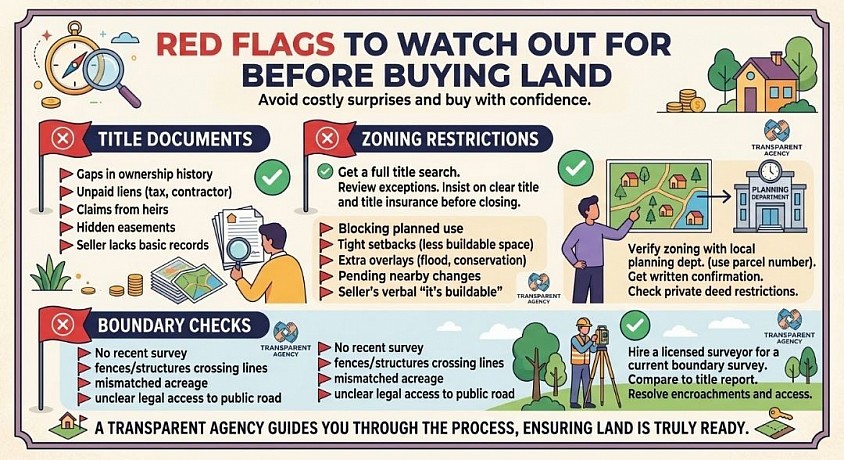
Red flags to watch out for before buying a land
The Beginner's Guide to Property Land Titles in Nigeria (C of O, Gazette, & Excision Explained)
C of O explained
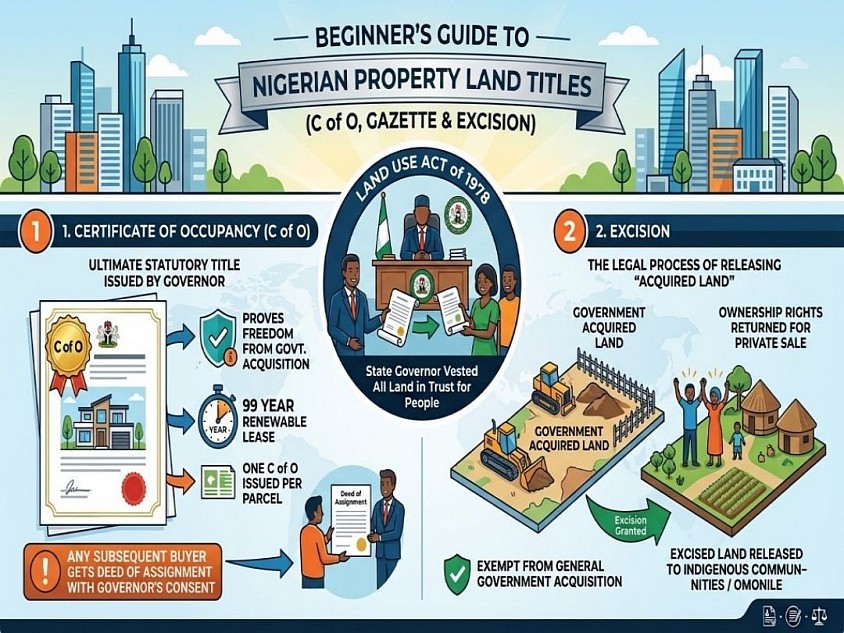
Understanding property land titles in Nigeria is the single most important step to preventing land loss, fraudulent sales, or government acquisition.
Under the Land Use Act of 1978, all land within a state's territory is vested in the State Governor, who holds it in trust for the people.
Here is a clear breakdown of how land titles work, from basic perfection stages to absolute ownership documents.
1. Primary Land Titles & Statuses
- Certificate of Occupancy (C of O)
The Certificate of Occupancy is the ultimate statutory land title issued directly by the state governor. It grants the holder official ownership and statutory right of occupancy for a renewable lease period of 99 years.
Key Feature: Proves that the land is completely free from government acquisition.
Important Rule: A governor issues only one C of O on a specific parcel of land. Any subsequent buyer of that property receives a Deed of Assignment with Governor's Consent, not a second C of O.
- Excision
Excision is the legal process where a state government releases or carves out a portion of "acquired land" back to original indigenous communities or land-owning families (Omonile).
How It Works: Once an excision is granted, that specific expanse of land is officially exempt from general government acquisition, returning ownership rights back to the community for private sale.
Why Should You Invest in Real Estate?
Why you should invest in real estate
- Beats Inflation: As the cost of everyday goods rises, property prices and rental rates usually go up too, protecting your money from losing power.
- Steady Extra Income: Owning a rented house gives you a regular cash flow you can count on.
- High Demand: Millions of people in Nigeria need homes to live in, meaning there are always buyers and renters looking for good property.
- Real, Physical Asset: Unlike paper investments that can drop overnight, land is a physical item you own and can pass down to your children.
Simple Ways to Start Investing
What’s Your Land Buyer Persona?
Types of land buyers
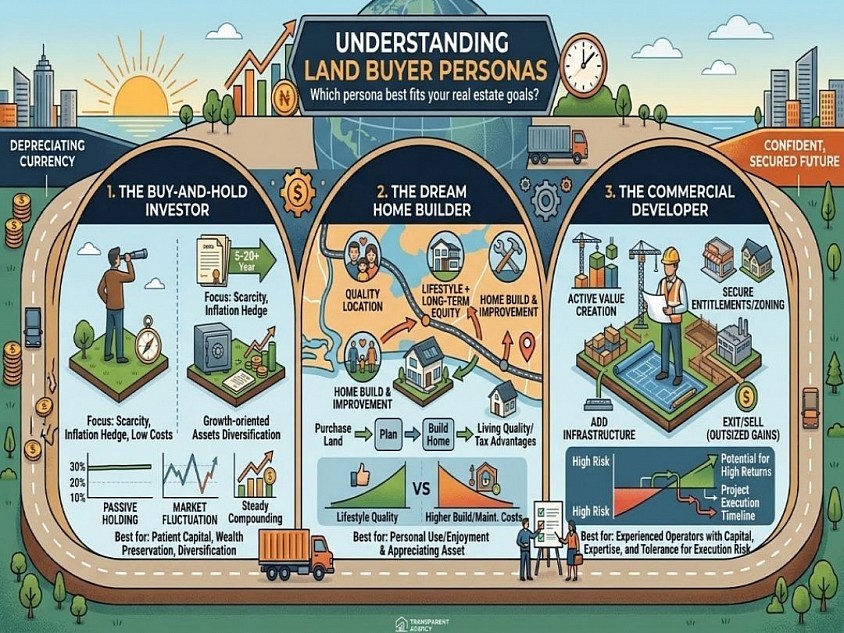
1. The Buy-and-Hold Investor
Buys land purely for long-term appreciation and holds it passively.
Focus: Scarcity, inflation hedge, low costs
Strategy: Purchase raw or agricultural land, pay taxes, wait (often 5–20+ years)
Pros: Minimal work, steady compounding, strong security
Cons: Little/no cash flow, illiquid, opportunity cost vs. stocks
Best for: Patient capital, wealth preservation, diversification
2. The Dream Home Builder
Buys land with the primary goal of building a personal residence (or second home).
Focus: Lifestyle + long-term equity
Strategy: Choose location for living quality, build or improve, live there (or plan to)
Pros: Personal use/enjoyment, potential tax advantages, emotional value
Cons: Higher costs (building, utilities, maintenance), less pure investment return
Best for: People who want both a home and an appreciating asset
3. The Commercial Developer
Buys land to develop and sell (or lease) for profit—residential lots, retail, industrial, etc.
Focus: Active value creation and higher returns
Strategy: Secure entitlements/zoning, add infrastructure, develop, exit
Pros: Potential for outsized gains, control over outcome
Cons: High risk, capital intensive, complex (permits, construction, market timing)
Best for: Experienced operators with capital, expertise, and tolerance for execution risk
Why Land Banking in Epe, Ibeju-Lekki, and Fast-Developing Hubs Beats Inflation.
Why land banking beats inflation
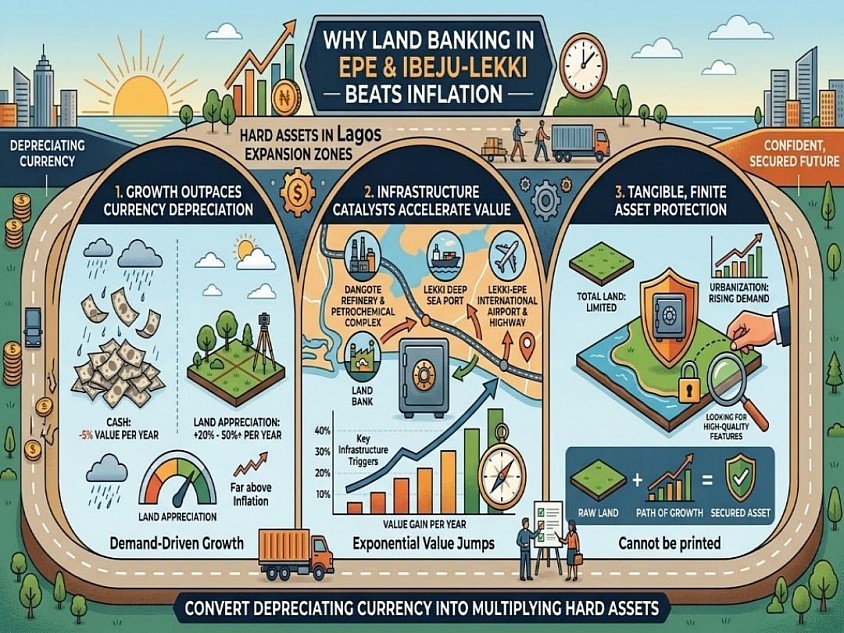
Land banking in fast-developing corridors like Epe and Ibeju-Lekki acts as a powerful hedge against inflation for three primary reasons:
1. Growth Outpaces Currency Depreciation
While inflation erodes the purchasing power of cash sitting in bank accounts, land in active infrastructure corridors consistently grows faster than local inflation. In Ibeju-Lekki and Epe, capital appreciation is driven by intrinsic demand rather than just monetary baseline shifts.
2. Infrastructure Catalysts Accelerate Value
These hubs benefit from massive government and private sector projects—such as:
- The Dangote Refinery & Petrochemical Complex
- Lekki Deep Sea Port
- Lekki-Epe International Airport & Highway Corridors
These mega-projects drive rapid residential, commercial, and industrial expansion, creating exponential value jumps (often 20% to 50%+ annually) that comfortably beat inflation.
3. Tangible, Finite Asset Protection
Unlike financial assets or fiat currency, land cannot be printed or created. Because total land area in prime expansion zones is strictly limited, rising population and urbanization continuously push up property values over time.
Key Takeaway: By securing raw land at entry-level prices in path-of-growth corridors, your money is converted from a depreciating currency into a hard asset that naturally multiplies in value as surrounding development matures.
